
Table of Contents
ToggleCritical Escalation: Israel Iran Conflict and Its Profound Impact on the Indian Stock Market
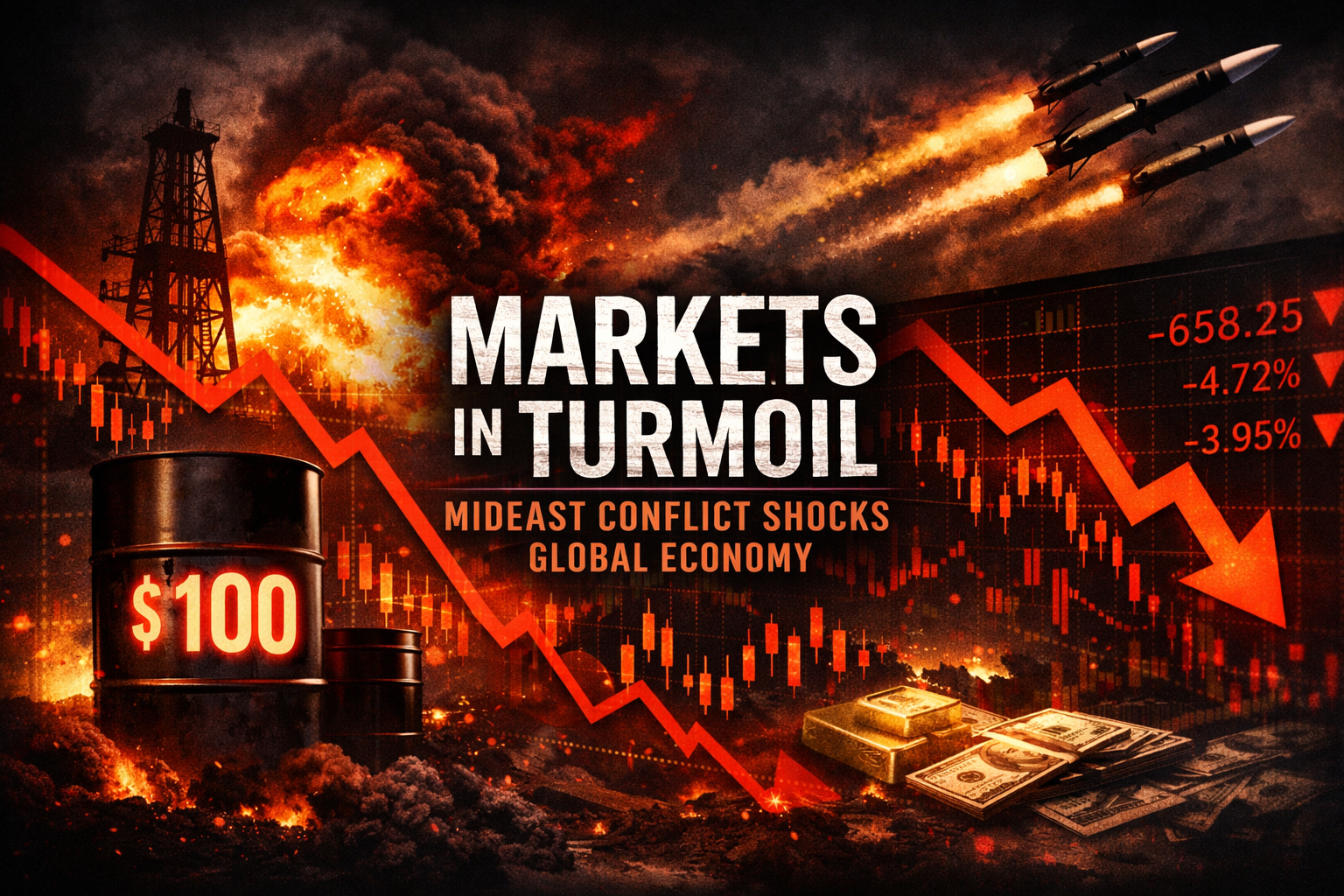
On February 28, 2026, geopolitical tensions in the Middle East reached a critical threshold as Israel and the US launched coordinated strikes against Iran ("Operation Epic Fury"). In a swift retaliation, Iran fired a barrage of missiles and drones, triggering air defense systems across the Gulf, with explosions reported in Abu Dhabi (UAE) and Doha (Qatar).
For the Indian Stock Market and the broader domestic economy, this escalation presents immediate macroeconomic challenges. A sudden spike in volatility, shifting Foreign Institutional Investor (FII) sentiment, and a surge in global crude oil prices are actively reshaping near-term market trajectories on Dalal Street.
📊 Pulse of the Crisis: Key Data Points
| Primary Flashpoints | Tehran, Abu Dhabi, Doha |
| Expected Market Opening | Sharp Gap-Down ↓ |
| Global Oil Risk Premium | +$5 to $15 / Barrel |
| FII Sentiment Outlook | Highly Risk-Averse |
Market Context: With over 20% of global oil flows passing through the Strait of Hormuz, the disruption caused by intercepted missiles over the UAE and Qatar immediately prices a high Geopolitical Risk Premium into emerging markets like India.
📉 Immediate Impact on the Indian Stock Market
Historically, the Indian equity markets harbor a profound sensitivity to Middle Eastern geopolitical instability. As news of the UAE and Qatar missile interceptions spread, an immediate flight to safety was observed across Asian indices.
Analysts note that benchmark indices like the Nifty 50 and Sensex invariably experience substantial "gap-down" openings during such global shocks. This initial deterioration in medium-term momentum often breaches heavily defended technical support levels as algorithmic trading systems scale back exposure to risk assets.
Historical Volatility Index (India VIX) vs Geopolitical Events
The Crude Oil Correlation & Inflationary Pressures
India's economic machinery is deeply reliant on energy imports, purchasing over 80% of its crude oil requirements from international markets. Consequently, any disruption in the Middle East functions as an immediate macroeconomic headwind.
Following the "Operation Epic Fury" strikes and subsequent retaliations, global oil markets swiftly priced in a risk premium of $5 to $15 per barrel. A direct threat to the Strait of Hormuz—the critical chokepoint for global energy transit—creates substantial upward momentum for Brent Crude.
The Ripple Effect on the Indian Economy
- Widening Current Account Deficit (CAD): Escalating oil prices exponentially increase India's import bill, placing immediate depreciative pressure on the Indian Rupee (INR).
- Imported Inflation: Elevated freight and fuel costs cascade into domestic logistics, squeezing corporate profit margins and pushing up the cost of everyday goods.
- GDP Growth Drag: Historically, a sustained $10 increase in oil prices has the potential to shave off 0.3% to 0.4% from India's GDP growth matrix.
When oil prices surge unexpectedly, Foreign Institutional Investors (FIIs) generally view emerging markets that are net energy importers (like India) as highly vulnerable, accelerating capital outflows.
The Institutional Tug-of-War: FII Outflows vs DII Resilience
During periods of heightened geopolitical risk, capital invariably flows toward traditional safe havens: the US Dollar, Gold, and US Treasuries. For the Indian markets, this instantaneous "risk-off" environment triggers significant selling pressure from Foreign Institutional Investors (FIIs).
As the conflict surrounding the Gulf escalates, FIIs systematically de-risk their emerging market portfolios. This massive liquidation particularly affects large-cap blue chips, banking heavyweights, and sectors with high foreign ownership, causing sharp intraday corrections across the indices.
| Institutional Category | Expected Market Behaviour |
|---|---|
| Foreign Institutional Investors (FII) | Aggressive Net Sellers (Risk-Off) |
| Domestic Institutional Investors (DII) | Strategic Absorbers (Buy on Dips) |
| Retail Investors | Volatility Prone / Panic Selling Risk |
However, the structural resilience of the Indian market is anchored by the historic SIP (Systematic Investment Plan) inflows from Domestic Institutional Investors (DIIs). While FIIs pull capital out, DIIs systematically deploy their vast liquidity reserves to absorb the selling pressure at lower valuations, creating a floor against an absolute market crash.
Sectoral Rotation: The Winners and Losers
A geopolitical crisis in the oil-rich Middle East triggers immediate sectoral rotation within the Indian equity markets. Portfolio managers rapidly reallocate capital, favoring defensive sectors while abandoning vulnerable cyclicals.
The Vulnerable Sectors
- Oil Marketing Companies (OMCs): Refining margins collapse as they cannot immediately pass spiking crude costs to consumers due to political controls.
- Aviation & Logistics: Jet fuel (ATF) and diesel constitute their largest operational expenses. Higher crude devastates profitability.
- Paints & Tires: Highly reliant on crude oil derivatives for their fundamental raw materials. margins are squeezed instantly.
The Resilient Sectors
- Upstream Oil & Gas Explorers: Companies lifting crude directly benefit from higher price realizations per barrel on the international market.
- IT & Pharma (Defensives): Capital flows toward these dollar-earning sectors. A depreciating Rupee marginally improves their export competitiveness and translation realization.
- Gold Financiers: A surge in safe-haven gold prices bolsters the collateral value for gold-lending non-banking financial companies (NBFCs).
Monetary Policy Shifts: The RBI's Response Architecture
Prior to the Israel-Iran escalation, market consensus anticipated an impending pivot toward interest rate cuts by the Reserve Bank of India (RBI) to stimulate domestic growth. However, the sudden introduction of a severe geopolitical risk fundamentally alters this trajectory.
Because inflated oil prices rapidly translate into broader domestic inflation (CPI), the central bank is often forced into a holding pattern. Rate cuts are systematically postponed until global crude stabilizes. In extreme scenarios of sustained currency depreciation, the RBI must aggressively intervene by depleting its foreign exchange reserves, selling dollars to defend the Rupee.
The High Interest Rate Environment: A "higher for longer" interest rate environment stifles credit demand and raises the borrowing costs for Indian corporates, indirectly dampening long-term corporate earnings expectations and stalling the equity markets' upward momentum.
Market Observations & Navigating Geopolitical Uncertainty
Global financial markets are reacting dynamically to the ongoing conflict. As the situation fluidly develops between Israel, Iran, and the overarching Gulf region, extreme intraday volatility is expected to remain a prominent feature on both the NSE and BSE indices.
When external shocks instigate a broad market correction, institutional participants frequently utilize these pronounced dips to rebalance portfolios, acquiring fundamentally robust equities at lower price multiples. Historically, such geopolitical disruptions generate significant short-term corrections, followed by varying periods of consolidation as supply chain anxieties dissipate.
⚠️ Important Regulatory & Educational Disclaimer
The content provided herein serves strictly for educational and informational purposes only. It details factual macroeconomic data and structural market observations.
We do not offer any financial, investment, trading, or portfolio allocation advice. We are not recommending buying or selling any specific assets. Due to the high risk and extreme volatility present in the financial markets, readers are strongly advised to rigorously consult with a certified, SEBI-registered financial advisor before initiating any strategic market action.
❓ Frequently Asked Questions (FAQ)
How does the Israel-Iran conflict impact the Indian stock market?
The conflict introduces severe geopolitical risk, typically resulting in strong "gap-down" openings on the Nifty 50 and Sensex. It triggers heavy selling pressure from Foreign Institutional Investors (FIIs) who move capital to safer havens.
Why do oil prices surge during Middle East tensions?
With over 20% of global oil flowing through the Strait of Hormuz, regional instability immediately threatens global supply chains. Markets react by pricing in a sudden "risk premium," often elevating Brent Crude by $5 to $15 per barrel.
Which Indian sectors are most vulnerable to geopolitical shocks?
Sectors highly dependent on crude oil, such as Aviation, Paints, Tires, and Oil Marketing Companies (OMCs), face severe margin contraction. Conversely, Upstream Oil Explorers and defensive IT/Pharma sectors often demonstrate resilience.
