
Table of Contents
ToggleSensex Crashes 849 Points: Unpacking the 5 Critical Factors Behind the ₹6 Lakh Crore Market Wipeout
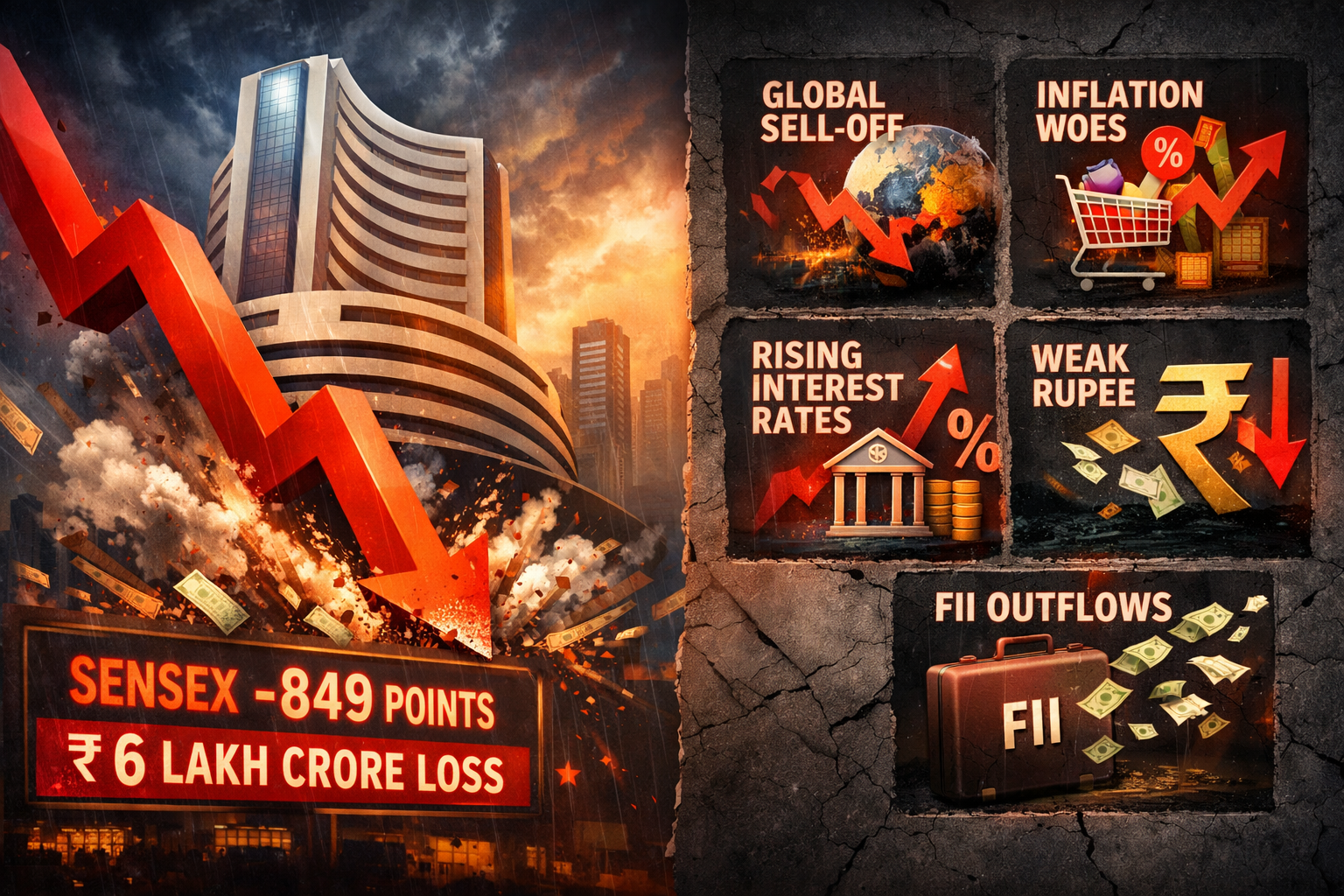
The Indian Stock Market witnessed a fierce across-segment selloff, resulting in massive wealth destruction on Dalal Street. The benchmark BSE Sensex violently shed over 849 points (1.04%), settling under the critical 80,800 mark, while the broader Nifty 50 recorded a stark decline of 256 points to close at 24,712.
The broader market breadth was decidedly negative, with the Midcap and Smallcap indices underperforming the benchmarks. In a single trading session, the overall market capitalization of BSE-listed firms evaporated from ₹455 Lakh Crore to ₹449.4 Lakh Crore, making investors significantly poorer by nearly ₹6 Lakh Crore. But what exactly drove this sudden capitulation?
📊 Market Capitulation: The Data Points
| Sensex Closing | 80,786 (-849 pts) ↓ |
| Nifty 50 Closing | 24,712 (-256 pts) ↓ |
| Wealth Destroyed | ~₹6 Lakh Crore |
| Primary Catalysts | Global Trade Wars & Valuations |
Factor 1: The Escalation of Trump Tariff Jitters
The primary catalyst heavily weighing on investor sentiment stems directly from Washington. Contrary to previous diplomatic expectations of a potential trade truce, India now faces a severe economic challenge: a proposed 50% secondary tariff on its exports to the United States.
The Trump administration recently published a draft notice detailing this aggressive plan, primarily aimed at pressuring Russia by economically penalizing nations that engage in significant trade with it via secondary constraints. A looming impending deadline with no active US-India trade negotiations has severely spooked export-oriented sectors.
The Broader Trade War Reality: Compounding the instability, President Trump threatened additional tariffs against countries imposing digital taxes on US tech firms, signaling that a global trade war may linger much longer than analysts initially projected.
Factor 2: The Earnings-Valuation Mismatch
A lingering, structural vulnerability in the Indian market has been its historically elevated valuations. The market consistently trades at a premium, currently hovering around 19 times the projected FY27 earnings, a metric considered decisively expensive by global standards.
When high valuations encounter muted or weak corporate earnings, a critical "mismatch" forms. This dynamic transforms the market into a "sell on rise" environment, where investors aggressively book profits at every minor rally rather than accumulating long-term positions.
The Cautious Outlook
While domestic experts project potential earnings improvement entering Q3 FY26 (driven by a low base effect, a robust monsoon, and GST rationalization), the market typically discounts future positive catalysts well in advance. Hence, the current premium multiples offer zero margin of safety against global macroeconomic shocks.
Factor 3: Relentless FII Capital Outflows
The liquidity backbone of emerging markets relies heavily on Foreign Institutional Investors (FIIs). Throughout 2025 and moving into August, FIIs have been relentless net sellers of Indian equities. This persistent outflow creates sustained downward momentum primarily in large-cap index heavyweights.
| Timeline | FII Cash Segment Outflows |
|---|---|
| July 2025 | ₹47,667 Crore Sold |
| August 2025 (MTD) | ₹28,217 Crore Sold |
While a stable US Dollar index makes US bonds an attractive, risk-free alternative, FIIs are tactically reducing exposure in sectors showing slower growth within India. Interestingly, institutional capital is simultaneously rotating into the primary market (IPOs) to capture value in new themes, while systematically aggressively exiting secondary cash market holdings.
Factor 4: Fractured Global Cues & Central Bank Drama
The reverberations of the US political climate severely compromised Asian market stability. Key regional indices plummeted in unison, with Japan’s Nikkei and South Korea’s Kospi both tracking steep losses mimicking the US Wall Street indices.
This broad global selloff was largely triggered by controversial moves within the US Federal Reserve. Investors were startled when Donald Trump abruptly dismissed Federal Reserve Governor Lisa Cook over alleged mortgage loan misconduct. Simultaneously, the US President continued an aggressive public pressure campaign against Fed Chair Jerome Powell, demanding immediate and steep interest rate cuts.
The Confidence Deficit: These unprecedented actions inherently raise severe questions regarding the independence of the US central bank. When institutional credibility fractures in the world’s largest economy, global funds immediately pull out of emerging risk assets (like India) and flood into dollar liquidity.
Factor 5: The Psychological and Technical 25k Hurdle
Beyond macroeconomic fundamentals, precise technical resistance acts as a strict ceiling on market ascensions. The highly anticipated 25,000 level for the Nifty 50 continues to function as a monumental psychological and technical hurdle.
As the index approaches this historic landmark, heavy, automated algorithmic profit booking invariably triggers. The Nifty formed a long bearish candle on the daily charts, signifying aggressive supply zone rejection, whilst maintaining a lower-top technical formation during intraday tracking.
Immediate Support Zones
With the Nifty slipping decisively below its critical 20-day exponential moving average (20-DEMA), technical analysts project a potential retest of lower support thresholds stretching from 24,600 to 24,500 to fill the recent analytical "gap."
Bank Nifty Weakness
Simultaneously, the crucially weighted Bank Nifty forcefully breached its foundational base around the 54,900 matrix, directly correlating to the widespread panic exiting in large-cap banking equities.
Navigating Volatility: Market Observations & Structure
The dramatic 849-point contraction of the BSE Sensex emphatically illustrates the inherent fragility of momentum-driven bull markets when confronted with severe, concurrent geopolitical and institutional liquidity shocks.
While algorithmic selling and panicked retail liquidations characterized the day's steep decline, sophisticated institutional desks consistently utilize such high-volatility events to systematically recalibrate and re-weight their core sector exposures away from overvalued segments into historically defensive moats.
⚠️ Important Regulatory & Educational Disclaimer
The content provided herein serves strictly for educational and informational purposes only. It details factual macroeconomic data, news-driven market mechanics, and structural market observations.
We do not offer any financial, investment, trading, or portfolio allocation advice. We strictly do not recommend buying or selling any specific assets. Due to the extreme volatility associated with gap-down openings and geopolitical events, readers are heavily advised to consult with a certified, SEBI-registered financial advisor before taking any strategic action in the equities market.
❓ Frequently Asked Questions (FAQ)
Why did the Indian stock market fall today?
The market experienced a massive selloff driven primarily by the escalating threat of Trump tariffs closely linked to the Russia-Ukraine war, aggressive foreign institutional selling, expensive domestic valuations, and technical resistance at the 25,000 Nifty level.
What is the new Trump tariff threat for India?
The Trump administration has formally outlined a draft notice proposing a severe 50% secondary tariff on Indian exports. This measure is reportedly designed to apply secondary pressure on nations conducting commerce with specific geopolitically sensitive countries.
Why are FIIs relentlessly selling Indian shares?
Foreign Institutional Investors (FIIs) are systematically withdrawing from the secondary cash market—over ₹28,000 crores in August alone—due to an earnings-valuation mismatch, rotating that specific capital toward emerging primary market (IPOs) themes instead.
