
Table of Contents
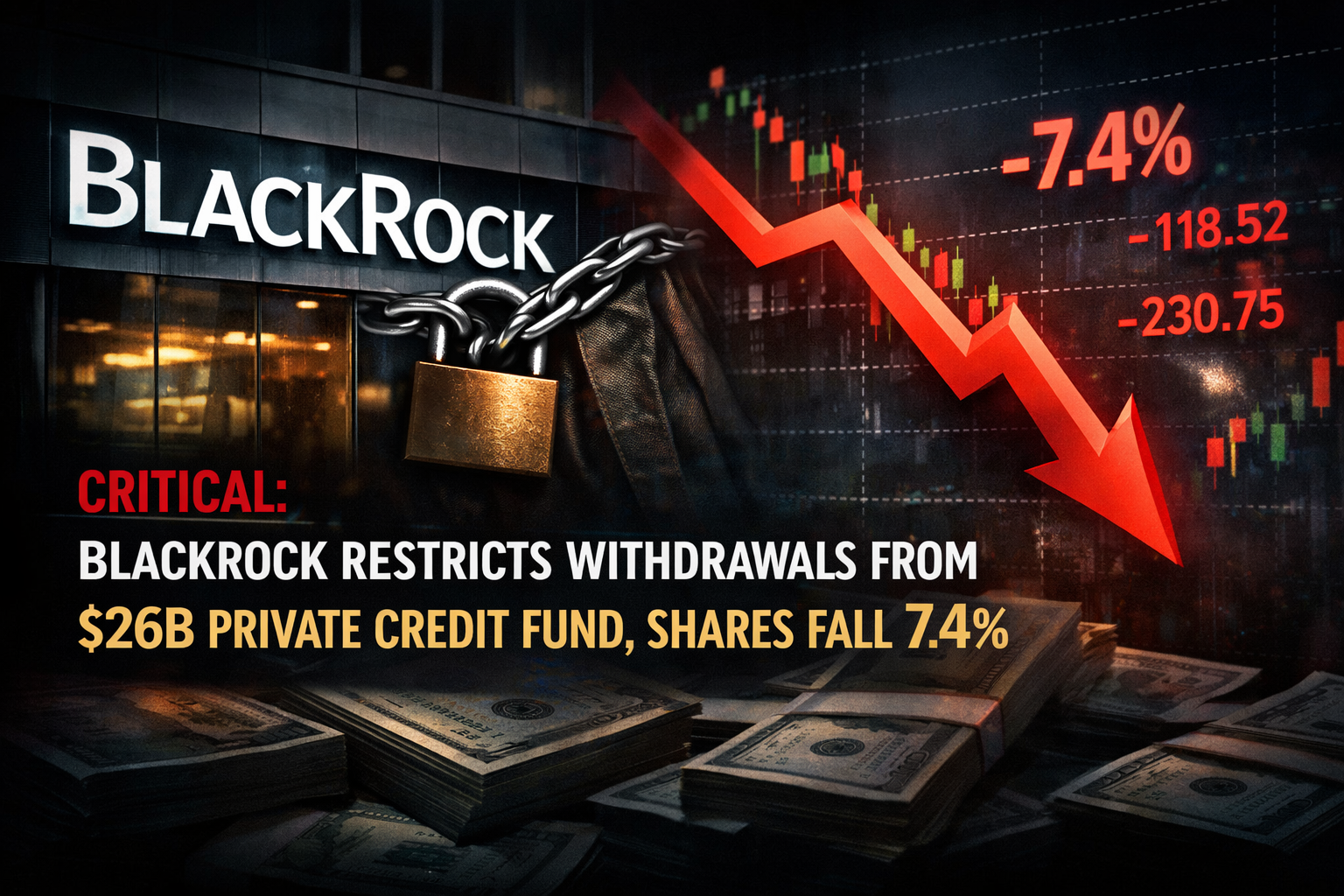
ToggleCritical: BlackRock Restricts Withdrawals from $26 Billion Private Credit Fund — Shares Plunge Over 7%
In a significant development shaking the global private credit market, BlackRock — the world's largest asset manager with over $11.5 trillion in AUM — activated withdrawal restrictions on its flagship HPS Corporate Lending Fund (HLEND), a $26 billion private credit vehicle.
The move, which occurred in early March 2026, marked the first time in the fund's four-year history that investor redemption requests exceeded the fund's built-in 5% quarterly repurchase cap. BlackRock's shares registered a notable single-day decline of 5% to 7.4% on March 6, 2026, as the market reacted to the news.
📊 The BlackRock HLEND Incident: Key Data
| Fund Name | HPS Corporate Lending Fund (HLEND) |
| Fund Size (AUM) | ~$26 Billion |
| Redemption Requests | ~$1.2B (9.3% of NAV) |
| Amount Distributed | ~$620 Million (5% cap) |
| BLK Share Decline (Mar 6) | -5% to -7.4% ↓ |
Understanding the HPS Corporate Lending Fund (HLEND)
The HPS Corporate Lending Fund stands as one of the most significant private credit vehicles in the alternative asset management landscape. The fund primarily extends private loans — also known as direct lending — to mid-sized companies that lack direct access to conventional public bond markets or major bank credit lines.
Launched four years prior, the fund grew rapidly as institutional appetite for private credit surged. Unlike publicly traded bonds or liquid equity instruments, loans extended through private credit vehicles are long-duration commitments, by design, they are difficult to liquidate quickly without incurring penalties or significant discount on the underlying loan portfolio.
Redemption Requests vs. 5% Fund Cap (Q1 2026)
Why Did Redemption Requests Surge to $1.2 Billion?
The unprecedented surge in withdrawal requests during Q1 2026 was driven by a confluence of macroeconomic and structural pressures that collectively eroded investor confidence across the broader alternative asset space:
- Rising Global Risk Aversion: Escalating geopolitical tensions across the Middle East and the lingering impact of US tariff policies created a broader flight to safety among institutional allocators. Many opted to reduce exposure to illiquid alternative assets as uncertainty climbed.
- Interest Rate Sensitivity: With US Federal Reserve policy remaining ambiguous, investors holding private credit — which typically locks capital for 3-7 years — became increasingly cautious about the opportunity cost of illiquid positions relative to higher-yielding, liquid US Treasury alternatives.
- Broader Liquidity Reassessment: Institutional portfolio managers began recalibrating their illiquid-to-liquid asset ratios after sustained volatility across equities. The private credit space, despite its higher yield, suddenly appeared too constrained for environments requiring rapid portfolio flexibility.
The Fund Mechanics: At 9.3% of net asset value, the $1.2 billion in Q1 requests sharply breached the structural 5% quarterly repurchase limit. Only the $620 million proportional share was distributed — leaving nearly $580 million of requests marked for further processing.
The Market Reaction: Why Did BlackRock Shares Fall 7.4%?
BlackRock's stock (NYSE: BLK) fell in a range of 5% to 7.4% on March 6, 2026 — a significant single-day correction for a company of its stature. The market's reaction unfolded across several distinct channels:
Reputational Signal
Activating the redemption cap — even though it is a legitimate contractual feature — publicly signals a mismatch between investor sentiment and the liquidity profile the fund projects. Markets re-rated the risk attached to BlackRock's alternative asset management division.
Sector-Wide Contagion
The broader alternative asset management sector experienced sympathy selling pressure. Investors rapidly reassessed the valuation premiums carried by firms like Apollo, Ares, and KKR, all of which manage similar private credit and illiquid alternative structures.
| Metric | Value |
|---|---|
| BLK Stock Move (Mar 6) | -5% to -7.4% |
| Sector Peers Affected | Apollo, Ares, KKR (sympathy sell-off) |
| Core Driver | Liquidity Risk Premium Re-rating |
The $2 Trillion Private Credit Industry: Growing Structural Risks
The BlackRock episode shines a powerful spotlight on a structural vulnerability that has been quietly building within the rapidly expanding $2 trillion global private credit industry. Analysts and regulators have increasingly flagged what is now termed a "liquidity illusion" — the false perception that semi-liquid private credit products can deliver both illiquid-asset yields and near-liquid redemption flexibility.
Several structural tensions now come to the fore within the sector:
- Asset-Liability Duration Mismatch: Private credit loans can span 5-10 years, while retail investors often expect quarterly liquidity. This fundamental mismatch only amplifies under market stress.
- Valuation Opacity: Unlike exchange-traded fixed income, private credit assets are marked-to-model rather than mark-to-market. This delay in reflecting true market pricing creates an inherently unstable redemption dynamic during volatility.
- Rapid AUM Growth: The private credit asset class has nearly doubled in size within five years, absorbing increasing amounts of retail capital through semi-liquid fund structures that may not have been stress-tested for large simultaneous redemptions.
The BlackRock HLEND event did not trigger a systemic collapse, but analysts widely described it as a decisive "warning signal" — the clearest indication yet that the private credit sector's growth has outpaced its structural safeguards.
Implications for Alternative Asset Allocation in India
While the BlackRock HLEND incident is a global private credit event, it carries important structural lessons for the rapidly maturing Indian alternative investment fund (AIF) ecosystem. India's AIF industry now manages over ₹12 Lakh Crore in committed capital, with Category II AIFs — which include private credit and debt-focused funds — experiencing the fastest pace of growth.
High-net-worth investors (HNIs) and family offices in India are increasingly allocating to structured credit, performing credit, and direct lending strategies through AIFs. The BlackRock episode serves as a pointed reminder of the critical importance of understanding the lock-in provisions, redemption structures, and liquidity waterfall mechanics of these instruments before committing capital.
Key Differentiators for Indian Investors
- SEBI-regulated Category II AIFs in India are closed-ended by structure and do not offer quarterly redemptions, which inherently reduces the asset-liability mismatch risk observed in global semi-liquid funds.
- The SEBI AIF framework and SEBI's investor awareness guidelines mandate detailed disclosure of liquidity risks in AIF placement memorandums.
Market Observations: Liquidity Risk & the Future of Private Credit
The broader financial market consensus is treating the BlackRock HLEND episode as a structural inflection point for the private credit industry. The fund's disciplined activation of its contractual 5% redemption cap — while arguably the correct operating procedure — has fundamentally reopened the conversation around how retail-adjacent alternative structures should communicate and manage liquidity expectations.
Institutional observers note that the primary concern is not the specific HLEND mechanism itself, but the broader question: how many other large semi-liquid private credit funds globally are holding similar imbalances? If redemption pressures simultaneously hit multiple funds, the sector could face a concentrated liquidity challenge.
⚠️ Important Regulatory & Educational Disclaimer
The content herein is strictly for educational and informational purposes only. It presents factual news analysis and structural market observations. This is not financial advice of any kind.
We do not recommend buying, selling, or holding any specific asset or instrument. Readers are strongly advised to consult with a certified, SEBI-registered financial advisor before making any allocation decisions related to alternative investment funds, private credit instruments, or equities.
❓ Frequently Asked Questions (FAQ)
Why did BlackRock restrict withdrawals from its fund?
BlackRock's HPS Corporate Lending Fund (HLEND) received redemption requests worth approximately $1.2 billion (9.3% of NAV) in Q1 2026, exceeding the fund's contractual 5% quarterly repurchase cap. The restriction is a foundational, pre-disclosed feature of the fund's structure designed to protect long-term investors from forced liquidation of illiquid private credit assets.
What is the HPS Corporate Lending Fund?
It is a $26 billion private credit fund managed by BlackRock that provides direct loans to mid-sized companies. It is a semi-liquid interval fund that allows quarterly redemptions up to 5% of its net asset value.
How much did BlackRock shares fall?
BlackRock's NYSE-listed shares (BLK) declined between 5% and 7.4% on March 6, 2026, following the news of the withdrawal cap being triggered for the first time in the fund's four-year history.
⚠️ Final Disclaimer
This analysis is strictly for educational and informational purposes only. We do not provide any investment advice. Please consult a SEBI-registered financial advisor before making financial decisions.
