
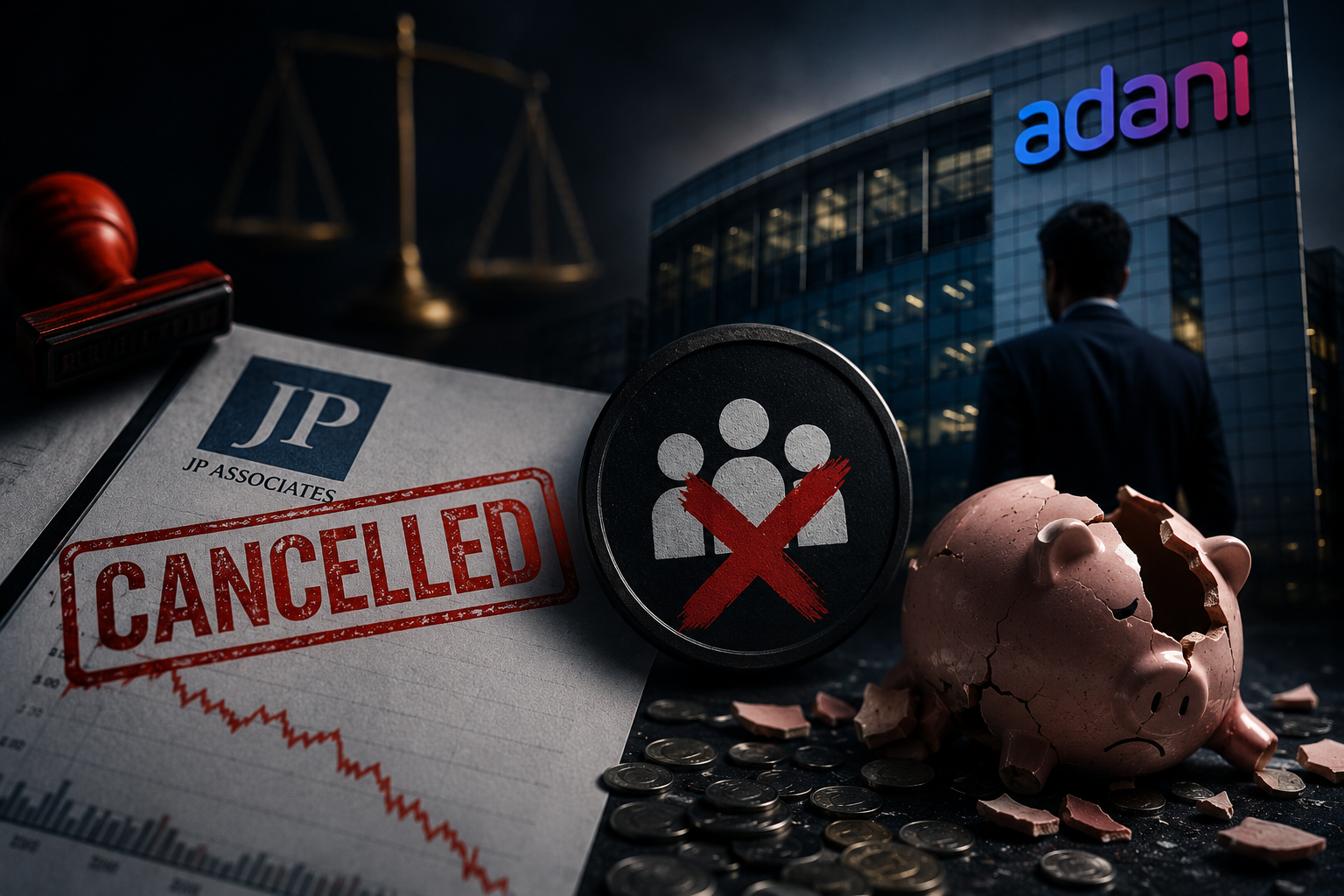
❓ What happens to JAL shareholders after the NCLT order?
All existing shares of Jaiprakash Associates Ltd (JAL) will be cancelled with zero payout to shareholders. The National Company Law Tribunal (NCLT) approved Adani Enterprises' ₹14,535 crore resolution plan on March 17, 2026, effectively wiping out ₹404.68 crore in investor wealth.
Table of Contents
ToggleJP Associates Share Cancelled: 6.4 Lakh Investors to Lose ₹404 Crore After NCLT Approves Adani Plan Cancelled: 6.4 Lakh Investors Set to Lose ₹404 Crore as NCLT Greenlights Adani's Resolution Plan
📊 Quick Market Facts
| Company | Jaiprakash Associates Ltd (JAL) |
| NCLT Approval Date | March 17, 2026 |
| Resolution Applicant | Adani Enterprises Ltd (AEL) |
| Resolution Plan Value | ₹14,535 Crore |
| Investor Payout | ₹0 (Zero) |
| Free-Float Market Cap Wiped | ₹404.68 Crore |
| Public Shareholders Affected | 6,45,466 |
| Total Loan Default (JAL) | ₹57,185 Crore |
In one of the most consequential insolvency resolutions in India's infrastructure sector, the National Company Law Tribunal (NCLT) pronounced an oral order on March 17, 2026, approving the resolution plan submitted by Adani Enterprises Limited (AEL) for the acquisition of Jaiprakash Associates Ltd (JAL) — a debt-laden infrastructure conglomerate based in Noida, Uttar Pradesh.
The decision, while bringing a definitive end to JAL's prolonged insolvency saga under the Insolvency and Bankruptcy Code (IBC), 2016, simultaneously delivers a severe financial blow to the company's 6,45,466 public shareholders. Under the approved plan, all existing shares of Jaiprakash Associates — including equity shares, preference shares, and all convertible instruments — will be completely cancelled and extinguished for zero consideration.
What Is Jaiprakash Associates Ltd (JAL)?
Jaiprakash Associates Ltd (JAL) is an Indian infrastructure and real estate conglomerate headquartered in Noida, Uttar Pradesh. The company was once a prominent name in India's infrastructure boom, with operations spanning cement manufacturing, hydropower projects, expressways, hotels, and sports facilities. JAL is a part of the broader Jaypee Group, which at its peak was involved in constructing some of India's largest infrastructure projects.
The company began experiencing severe financial stress when its massive capital expenditures outpaced its revenue generation, leaving it with a debt mountain that proved impossible to service. JAL was admitted to the Corporate Insolvency Resolution Process (CIRP) under the IBC, 2016, in June 2025, after formally defaulting on loan repayments totalling ₹57,185 crore to its creditor banks and financial institutions.
Why is JAL in the news today?
JAL is in the news because the National Company Law Tribunal formally approved the ₹14,535 crore resolution plan submitted by Adani Enterprises Ltd on March 17, 2026. This approval means that Adani Group will take ownership and control of JAL's assets, while all existing shareholders of JAL — including retail and institutional investors — will receive zero compensation as their shares are permanently cancelled.
The Adani Resolution Plan: How Did This Happen?
Adani Enterprises Ltd (AEL), the flagship listed entity of the Gautam Adani-led Adani Group, submitted a ₹14,535 crore resolution plan to acquire the assets and business of Jaiprakash Associates Ltd through India's formal insolvency resolution framework. The plan received overwhelming creditor support and was ultimately endorsed by the National Company Law Tribunal, Allahabad Bench.
How the Resolution Process Unfolded — Step by Step
- June 2025 — CIRP Admission: JAL was formally admitted to the Corporate Insolvency Resolution Process (CIRP) under the Insolvency and Bankruptcy Code (IBC), 2016, after defaulting on loan repayments worth ₹57,185 crore.
- Bids Received: Three major players submitted resolution plans — Adani Enterprises Ltd, Vedanta Group, and Dalmia Bharat (Dalmia Cement). The Committee of Creditors (CoC) evaluated all bids based on recovery value.
- November 2025 — CoC Approval: The Committee of Creditors formally approved the Adani Enterprises resolution plan, with AEL securing the highest vote share of 89% from creditors, significantly ahead of its rivals.
- March 17, 2026 — NCLT Order: The National Company Law Tribunal pronounced an oral order approving the resolution plan, marking the legal conclusion of the insolvency proceedings for Jaiprakash Associates.
- Within 90 Days — Share Cancellation & Delisting: All existing JAL shares are to be cancelled, and the company will be delisted from the NSE and BSE within 90 days of the effective date of implementation.
Many market participants are asking how Adani Enterprises — a company already managing a vast infrastructure portfolio — will integrate and restructure the Jaiprakash Associates assets. Analysts note that the acquisition gives Adani Group access to JAL's large cement, hydropower, and real estate asset base at a structured resolution price, potentially creating significant long-term value.
Why Are Investors Getting Zero? The IBC Repayment Hierarchy Explained
The most critical question on the minds of over 6 lakh JAL shareholders is: why are public investors receiving nothing? The answer lies within the rigid repayment hierarchy established under the Insolvency and Bankruptcy Code (IBC), 2016.
Under IBC rules, in any insolvency resolution, creditors are paid before equity holders — and this strict waterfall applies even when the total recovery is less than what is owed. In JAL's case, even secured creditors — who hold collateralised claims — are not being fully recovered from the ₹14,535 crore plan. Since the entire resolution amount is insufficient to even satisfy secured lenders in full, no residual value flows down to equity shareholders.
The IBC Repayment Waterfall
| Priority Level | Creditor Type | Recovery in JAL Case |
|---|---|---|
| 1st | CIRP Process Costs | Paid First |
| 2nd | Secured Financial Creditors (Banks) | Partial Recovery |
| 3rd | Unsecured Creditors | Minimal / Zero |
| 4th (Last) | Equity Shareholders | ₹0 — Zero |
The company's own exchange filing stated: "In the assessment of the Successful Resolution Applicant, the liquidation value is insufficient to even satisfy the claims of secured creditors in full, therefore, NIL consideration is being offered to the shareholders… and the exit price for the existing shareholders is therefore NIL."
What Is Exactly Being Cancelled — And Who Is Affected?
The approved resolution plan mandates the complete cancellation of all pre-insolvency share capital of Jaiprakash Associates Ltd. This is not a selective delisting or a partial write-off — it is a full extinguishment of every existing equity claim in the company.
What instruments will be cancelled?
- Equity Shares — all ordinary shares held by public and promoter shareholders.
- Preference Shares — all preference capital currently outstanding.
- Convertible Instruments & Warrants — any outstanding convertible bonds, compulsorily convertible debentures, or warrants.
Public Shareholders
6,45,466 public shareholders will lose the entire free-float market value of their holdings — estimated at ₹404.68 crore. These are retail investors, mutual funds holding small positions, and institutions who bought shares on the NSE or BSE.
Promoters
Promoter holdings will also be completely cancelled. The founding Jaypee Group family and related promoter entities will lose their entire ownership stake and operational control over the company permanently.
JAL: Before vs After the Resolution — A Structural Comparison
Investors often wonder how a company that was once listed and actively traded on both the National Stock Exchange (NSE) and the Bombay Stock Exchange (BSE) can end up with its shares being cancelled entirely. The comparison below illustrates the dramatic structural transformation Jaiprakash Associates is undergoing:
| Aspect | Before Resolution | After Resolution |
|---|---|---|
| Ownership | Jaypee Group Promoters + Public Float | Adani Enterprises Ltd |
| Existing Shares | Listed on NSE & BSE | Cancelled — Zero Value |
| Shareholder Payout | Implied Market Value (~₹404 Cr) | ₹0 (Zero) |
| Debt Status | ₹57,185 Cr outstanding default | Resolved via IBC |
| Listing Status | Listed (NSE/BSE) | Delisted within 90 days |
What could influence the market sentiment around this news?
The resolution of JAL's insolvency through the IBC framework is considered a positive signal for India's credit ecosystem — demonstrating that the insolvency resolution machinery can function and close large, complex cases. For creditors of Adani Enterprises, the expansion of asset base through JAL's infrastructure portfolio is a factor to track. Read the full details from Livemint: Livemint — JAL NCLT Approval Coverage.
Market Observations: What This Teaches Every Equity Investor
The Jaiprakash Associates resolution carries important structural lessons for retail and institutional equity participants across Indian capital markets. The outcome — where equity shareholders receive absolutely nothing despite the company having a listed market capitalization — is a direct consequence of how insolvency law prioritises creditor recovery over shareholder interests.
How significant is the JAL insolvency outcome for India's capital markets?
The JAL case is significant for two reasons. First, it conclusively demonstrates that holding shares in a company undergoing insolvency proceedings carries near-total risk of capital loss. Second, it reinforces the primacy of the IBC framework in resolving large-ticket corporate defaults — a critical pillar for the health of India's banking sector, which had ₹57,185 crore of loans exposed to JAL.
- Equity is the highest risk, last-paid instrument in any corporate capital structure. When a company enters insolvency, equity investors are last in the queue and often recover nothing.
- Market value does not guarantee recovery. JAL had a ₹404.68 crore free-float market cap, yet shareholders received zero — because the company's liquidation value could not cover secured creditors, let alone equity.
- Continued listing during CIRP can mislead investors. JAL shares continued trading on the NSE and BSE during the insolvency process. Investors who purchased during this period must have understood the associated risks, as further coverage from Business Standard outlines: Business Standard — JAL Resolution Plan Coverage.
⚠️ Important Disclaimer
This analysis is published strictly for educational and informational purposes only. The content provides factual news analysis and structural observations based on publicly available information and regulatory filings.
This is not investment advice of any kind. We do not recommend buying, selling, or holding any security. Readers are strongly advised to consult a SEBI-registered financial advisor before making any investment decisions related to insolvency-related or distressed securities.
❓ Frequently Asked Questions (FAQ)
What does it mean when JAL shares are cancelled?
It means all existing shares of Jaiprakash Associates Ltd (JAL) — whether held by retail investors, institutions, or promoters — will be permanently extinguished and removed from the NSE and BSE. Shareholders will receive zero rupees in return. The company's ownership will fully transfer to Adani Enterprises Ltd under the NCLT-approved resolution plan.
Who is Adani Enterprises and why did it acquire JAL?
Adani Enterprises Ltd (AEL) is the flagship listed company of the Adani Group, led by billionaire industrialist Gautam Adani. It submitted a ₹14,535 crore resolution plan and secured 89% creditor approval to acquire JAL's infrastructure assets — including cement plants, hydropower projects, and real estate holdings — through India's Insolvency and Bankruptcy Code (IBC), 2016.
How many investors will lose money in the JAL resolution?
Approximately 6,45,466 public shareholders of Jaiprakash Associates will lose a combined ₹404.68 crore — the total free-float market capitalisation of the company. No portion of the resolution plan proceeds will be distributed to equity shareholders.
When will JAL shares be delisted?
Following the NCLT order of March 17, 2026, JAL shares are expected to be cancelled and the company delisted from the NSE and BSE within 90 days of the effective implementation date of the resolution plan, in coordination with SEBI, stock exchanges, and the appointed resolution professional.
What was JAL's total debt when it entered insolvency?
Jaiprakash Associates Ltd had defaulted on loan repayments totalling ₹57,185 crore when it was admitted to the Corporate Insolvency Resolution Process (CIRP) in June 2025. This debt level was assessed as exceeding the company's liquidation value, leaving no residual value for equity shareholders.
⚠️ Final Educational Disclaimer
This blog is purely for educational and informational purposes. It does not constitute investment advice. Please consult a SEBI-registered financial advisor before making any investment-related decisions. Past share performance or insolvency outcomes are not indicative of future results.
